


EcoFlow Glacier Classic 45L Review: A Road Trip to the Italian Lakes With a Battery Fridge Freezer

Updated: Sep 23
Two nights in hotels before our first hook-up. A fridge freezer packed in the back of the van for 48 hours. And, somewhere in France, a 12V cable that quietly pulled itself out.

By Martin· Nest Nomad & Beyond · Last Updated August 2026
Bought with our own money. We paid for the EcoFlow Glacier Classic 45L ourselves, £560 including the battery while it was on offer. EcoFlow had no involvement in this review and no sight of it before it went live. As always, these are our full, unfiltered thoughts, the good, the bad and the ugly.
Our Halfords 12V camping fridge is well over ten years old. The 12V adapter died about five years ago, so we have been running it on the 230V mains adapter ever since. When we recently tested it off-grid on three different portable power stations for a week, we got roughly 13 to 14 hours out of it depending on the power pack. It was clearly due an upgrade.
With a road trip to Lake Maggiore and Lake Garda coming up, it felt like the right moment to test one of the much debated battery and 12V powered portable fridge freezers. Here is exactly what happened, including the part where the fridge died halfway across France and what we found when we finally opened the lid.
EcoFlow Glacier or Glacier Classic: which one did we buy?
There are two lines and the names do not make it obvious. The original EcoFlow Glacier includes a built-in ice maker. The Glacier Classic, which is what we bought, drops the ice maker and comes in at a lower price. Everything else we have described here, the dual zone, the plug-in battery, the app, is the Classic. If you have seen reviews raving about making ice in the back of a van, that is the other model. We did not miss it, but if ice matters to you, that is the one to look at.
Jump to

Why We Went for the EcoFlow Glacier Classic 45L
There are a few of these battery powered fridge freezers on the market now, from the likes of Anker, EcoFlow and BougeRV to name a few. We went with the Glacier Classic 45L for three reasons.
The first was capacity. We were used to a 40 litre set-up, but having a separate freezer section was new to us, so we went a little bigger. At the time of writing the Anker EverFrost comes in 23L, 40L and 58L, and the EcoFlow Glacier Classic comes in 35L, 45L and 55L. The 45L was the natural step up without jumping to the biggest box.
The second was the physical size of the thing. These are big. We have listed the full dimensions further down, but the published size of the Anker EverFrost 40L is 749 x 459 x 493mm against the EcoFlow's 706 x 400 x 480mm, and the EcoFlow gives you more capacity in the smaller footprint. In a van, that is a real consideration.
The third was price. At the time of writing the EcoFlow was around £100 cheaper. All of that considered, we took the plunge.
One small bonus worth flagging early: the Glacier comes with a 12V car adapter in the box. That turned out to matter a lot on this trip.
Our Test: 48 Hours in the Van Before the First Hook-Up
This trip was close to ideal test conditions. We had two overnight hotel stops before we reached our first campsite, which meant the Glacier would sit packed in the back of the van for at least 48 hours before it saw an electric hook-up at Campofelice on Lake Maggiore.
EcoFlow advertise up to 43 hours holding 4°C on the battery. But we were asking more of it than that. We wanted the freezer at minus 14°C and the fridge at 4°C, and we knew that would not last more than a few hours on the battery alone. So the plan was to run it off the van's 12V socket while we were driving, using the adapter that came in the box, and let the battery carry it overnight in the hotel car parks.
So, did it work?
Day One: 53% Battery After a Night in the Van

Our first drive was three hours from home to an overnight hotel in Folkestone, with the Glacier charging on the 12V the whole way. We arrived at around 11pm. With an early start in the morning, we plugged the fridge back in at about 6.30am and I checked the app.
To our pleasant surprise, we had used just 53% of the battery overnight. The app was showing eight hours of battery time remaining. What a result. The temperatures had held, and I suspect being packed in tight in the van had done the insulation a favour.
Day Two: The Cable Pulled Out
Day two started well, apart from an hour's delay on Le Shuttle. Then, three hours into the drive towards our overnight stop near Mont Blanc, I went to check on the Glacier in the app and found it was not charging. It had five hours of life left.
The 12V extension cable had pulled out of the EcoFlow's 12V connector. Frustratingly, the Glacier was now on its own, with no way to power it for at least another 24 hours.
By the time we pulled into the hotel, the battery had 47 minutes of charge left. The freezer was still at minus 14°C and the fridge at 2°C. To conserve what was left and keep the food frozen for the rest of the journey, I raised the freezer to minus 10°C and let the fridge come up to 6°C.
Day Three: Running on Nothing
We set off the following morning with the Glacier completely dead. It was no longer connecting to the app at all, and we had four hours of driving ahead of us.
We arrived at Campofelice on Lake Maggiore, opened it up, and found the freezer at minus 1°C and the fridge at 6°C.
Then we checked the food. The tuna steak was still frozen solid. The ice cream was a little mushy, but apart from that we were all good. The insulation and the battery had managed it, through a dead unit and four hours of driving in the Italian summer.
Once we plugged into the mains, the freezer was back down to minus 14°C by 8am the following morning. The remainder of the trip was without incident. Not a single issue, a solid minus 14°C and 2°C for the whole stay.
How Long Does the EcoFlow Glacier Battery Actually Last?

This is the question most people looking at this fridge want answered, so here is our honest experience rather than the brochure figure.
EcoFlow quote up to 43 hours holding 4°C on the 298Wh battery. We were running it much harder than that, with the freezer at minus 14°C, and we still got more out of it than we expected. Overnight in a hotel car park, packed in the van, it used 53% of the battery and was showing eight hours remaining in the morning. On the second night, after the cable had pulled out and it had been running unpowered for hours on the road, it still arrived with 47 minutes left. And even once it was fully dead, the insulation kept a tuna steak frozen for another four hours.
We would honestly say the battery lasts longer than advertised for the way we used it. The one real-world lesson is not to ask it to hold minus 14°C on battery alone for two days. Get it down to temperature on hook-up or 12V, and let the battery and the insulation do the carrying in between.
A bonus we ended up using every single night: the battery doubles as a power bank. I used it as my overnight phone charger in the awning and it worked without fail. The charging compartment is clean and has a nice ergonomic sliding cover.
Fridge at 2°C, Freezer at Minus 14°C: The Honest Bit on Temperature
If you are hoping to run the full 20 degree swing, a true minus 16°C freezer and a true plus 4°C fridge at the same time, we are not sure it is possible. We tried lots of different set-ups at home before we left, freezer empty and fridge full, fridge empty and freezer full, and every variation in between, and none of them hit that golden minus 16°C and plus 4°C.
What we got, consistently, was minus 14°C in the freezer and 2°C in the fridge. For us, the fridge sitting at 2°C rather than 4°C was no big deal. There was a very small amount of light frost on the bottom of the fridge compartment, but no fruit or veg was ruined and nothing in the fridge section actually froze. It is worth knowing going in, though. If you need a precise 4°C fridge alongside a deep freeze, this is not quite that.
The App
As we have said before in our EcoFlow Wave 3 and Delta 3 reviews, the EcoFlow app is top class. It is extremely easy to use, gives you all the key information at a glance, and detailed stats if you are connected over wifi. We checked it constantly on this trip and it never let us down.
One request, if the tech team at EcoFlow are reading this. When the Glacier has no power, it drops off the app entirely, which is exactly the moment you most want to see the temperature inside. A small button cell keeping the temperature gauge talking to the app even with the unit dead would be a genuinely useful addition.
Size and Weight: It Is Big, and We Nearly Left It at Home

I will be honest, when it arrived we had not appreciated how big it was. It dwarfs our old Halfords fridge. Given all the tech packed inside it, that is to be expected, but it is still a surprise when it lands on the doorstep.
It was a good fit for our van and we did not struggle to fit it in. If you are travelling by car, though, be mindful of the space it takes up. It is big. It is not as big as the Anker equivalent, which matters, especially given it has the larger capacity, but it is big.
Then there is the weight. It comes in at 23kg without any food in it. There are two fold-out carry handles, and I managed to lift it unaided from the van into the awning, a matter of ten metres or so. Any further than that and it is probably a two person job once you combine the weight with the rectangular shape.
Honestly, we very nearly did not take it. We thought it was too big and too heavy. But we soon got used to it, and after about a day with it in the van and on the pitch we did not think about it again.
Build Quality: Excellent, and Slightly Too Nice for Camping
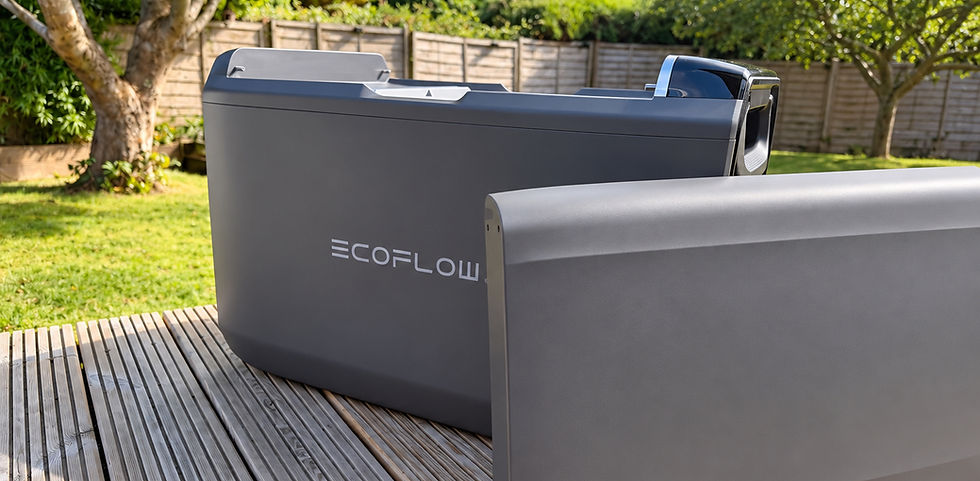
It has the excellent build quality you would expect from EcoFlow. Solid, well put together, and the LED screen is clean, clear and relatively easy to navigate.
If we have a niggle, it is the same one we had with the Delta 3. It is slightly too nice for camping. By the nature of what it is and how we use it, it is going to pick up scratches and scuffs, and the slick design does not quite fit that. The Anker looks more built for camping in that sense. But that is a comment on looks, not on how well it is made.
Does the EcoFlow Glacier Drain Your Car Battery?
We ran the Glacier off the van's 12V socket while we were driving, and with the engine running it charged its own battery and held temperature without any bother. We did not run it off the van's 12V with the engine off, so we cannot tell you from experience how long it would take to flatten a starter battery that way, and we would not recommend finding out on a trip.
Worth checking on your own vehicle: some 12V sockets are only live with the ignition on, which protects the starter battery for you. If yours stays live with the engine off, treat the Glacier's own battery as the overnight buffer rather than leaning on the car.
The thing that actually caught us out was simpler. The 12V cable pulled out of the connector on a rough stretch of road and we did not notice for a while. Check it is properly seated when you set off, and check it again after a bumpy section. We should mention there is an option on the app to turn on starter battery protection, which is designed to stop it draining the starter battery.
Will It Work Off-Grid? Solar and a Second Battery
We did not test this on the trip, so this is our honest thinking rather than a result.
With a second battery and some solar panels, we think this could work really well off-grid. The Anker EverFrost is able to accept two batteries, which is a genuinely interesting feature. If you are looking for an off-grid freezer, and you can get the freezer down to temperature before you set off, our feeling is that two batteries and around 200W of solar would keep you going. We would want to test that properly before we say it as fact.
Is the EcoFlow Glacier Classic Worth the Money?
The million dollar question. Literally, in this case.
It was on offer when we bought it, at £560 including the battery. Having not yet tested its direct rivals, or any of the standard 12V compressor fridge freezers that start from around £250, we are honestly not sure. We would be keen to test the Anker EverFrost and an Alpicool model before we give a proper verdict on value.
What we can say is this. If you are after a solid, well built portable fridge freezer, and you have the money to invest, then yes, for the price we paid, it is worth it. It did everything we asked of it, and a fair bit more once it had died.
Who Is the EcoFlow Glacier Classic 45L For?

It is for campervan and van owners who want a proper freezer section alongside a fridge, and who will mostly be on electric hook-up or driving with a 12V socket, with the battery carrying the gaps. It is for anyone who has been getting by with an ageing cool box or a basic 12V fridge and wants the step up to real, app-controlled, dual zone cooling. The space and the weight are worth it if you have a van to put it in.
It is not for car campers who are tight on boot space, because it is big and 23kg is a lot to lift in and out. It is not for anyone expecting to run for days off-grid on a single battery with the freezer at minus 14°C. And if you need the fridge section to hold a precise 4°C alongside a deep freeze, know going in that ours sat at 2°C.
Final Verdict
Three days of driving. Two hotel car parks. One dead fridge halfway across France, and a tuna steak that was still frozen solid when we opened the lid on Lake Maggiore.
Final Verdict |
|
BATTERY | 53% used overnight with the freezer at minus 14°C, and eight hours still showing in the morning. Lasts longer than advertised for the way we used it, and it doubles as a phone charger every night. |
INSULATION | The quiet hero. Kept frozen food frozen for four hours after the unit had completely died. |
TEMPERATURE | A solid minus 14°C freezer and 2°C fridge for the whole trip. The full minus 16°C and plus 4°C swing we could not achieve. Light frost in the fridge, nothing ruined. |
SIZE AND WEIGHT | 23kg and 706 x 400 x 480mm. Big, and we nearly left it at home. Fine in a van, think hard in a car. |
APP | Top class, as with every EcoFlow we have used. Drops off completely when the unit dies, which is our one request to EcoFlow. |
BUILD | Excellent, and slightly too nice for camping. It will scuff. |
ONE NOTE | The 12V cable pulling out. Check it is seated when you set off, and check it again after a rough road. |
A couple of honest caveats on size and on that 2°C fridge, then. But given what it did with a dead battery and a tuna steak, and how it ran without a single issue once it was on hook-up, it earned its place in the van. We just wish we had checked the cable.
Running a fridge off a battery is the same question whether it is in a van or a kitchen. We went through the runtime maths properly here.
Frequently Asked Questions
How long does the EcoFlow Glacier battery last?
EcoFlow quote up to 43 hours holding 4°C on the 298Wh battery. We ran ours harder, with the freezer at minus 14°C, and it used 53% of the battery overnight in the van with eight hours still showing the next morning. We would say it lasts longer than advertised for that kind of use. Get it to temperature on hook-up or 12V first and let the battery bridge the gaps.
How long will the EcoFlow Glacier run on battery alone?
In our test it ran through a full night and most of a day's driving after the 12V cable pulled out, arriving with 47 minutes left. Once it had fully died, the insulation still kept a tuna steak frozen solid for a further four hours in the back of the van. On battery alone with the freezer at minus 14°C, plan for roughly a day, not two.
Does the EcoFlow Glacier drain your car battery?
We only ran it off the van's 12V socket with the engine running, and it charged and held temperature without issue. We did not run it engine-off, so we cannot say from experience how quickly it would drain a starter battery, and we would not test that on a trip. Check whether your 12V socket is live with the ignition off, and treat the Glacier's own battery as the overnight buffer.
Can the EcoFlow Glacier run on solar?
The Glacier can be solar charged, but we did not test it on this trip. Our honest view is that with a second battery and around 200W of solar it could work well off-grid, provided you get the freezer to temperature before you leave. We will report back once we have tested it properly.
What temperature does the EcoFlow Glacier get down to?
EcoFlow rate it down to minus 25°C. In practice we ran the freezer at minus 14°C and the fridge at 2°C for the whole trip. We could not get a true minus 16°C freezer and plus 4°C fridge at the same time, whatever set-up we tried.
Is the EcoFlow Glacier Classic worth it?
For the £560 we paid on offer, including the battery, yes, if you want a solid, well built portable fridge freezer and have the budget. We have not yet tested the Anker EverFrost or the cheaper standard 12V compressor fridges, so we will hold off on a full value verdict until we have.
Which size EcoFlow Glacier should I get?
It comes in 35L, 45L and 55L. We went for the 45L, having been used to a 40L fridge, because the separate freezer section was new to us and we wanted a little more room. If you are in a car rather than a van, think carefully before going to the 55L, because even the 45L is big.
Does the EcoFlow Glacier come with a 12V car adapter?
Yes, the 12V car adapter is included in the box, which was a bonus and the reason we could run it while driving. Just make sure the cable is properly seated, because ours pulled out on a rough road.
Can you charge your phone from the EcoFlow Glacier battery?
Yes. The battery doubles as a power bank and I used it as my overnight phone charger in the awning every night of the trip without a single problem.
How heavy is the EcoFlow Glacier Classic 45L?
23kg without any food in it. It has two fold-out handles and one person can manage a short carry, but over any distance it is really a two person lift.
What are the problems with the EcoFlow Glacier?
In our experience: the 12V cable can pull out of the socket without warning, the app drops out completely when the unit loses power, the fridge section sat at 2°C rather than 4°C, and it is big and heavy. None of them stopped us using it, but all of them are worth knowing before you buy.
Is the EcoFlow Glacier better than a standard 12V compressor fridge?
We cannot say yet. Standard 12V compressor fridge freezers start from around £250 and we have not tested one against the Glacier. What the Glacier adds is the removable battery, the app and the dual zone, and whether that is worth the difference is exactly what we want to test next.
Product Specifications at a Glance
Figures below are manufacturer specifications from the EcoFlow product page, except weight and dimensions which we measured ourselves. Check the EcoFlow site for current pricing and availability.
Specification | Detail |
Model | EcoFlow Glacier Classic 45L |
Capacity | 45 litres |
Zones | Dual zone, fridge and freezer |
Temperature range | Minus 25°C to 10°C |
Battery | 298Wh plug-in battery, removable, doubles as a power bank |
Advertised runtime | Up to 43 hours at 4°C on battery |
Weight | 23kg, measured empty |
Dimensions | 706 x 400 x 480mm |
Charging | Mains, 12V car socket, solar |
App | EcoFlow app, detailed stats over wifi |
In the box | Glacier unit, 298Wh battery, mains adapter, 12V car cable |
Price | RRP around £599 for the unit and £299 for the battery. We paid £560 for both on offer. |
Related Reading
Sign up to be first to know when new posts go live.


Comments