


EcoFlow Delta 3 Review: A Week of Family Camping With No Hook-Up

Updated: Sep 23
A whole week camping in the Lake District without booking an electric hook-up. One old fridge, a projector, a family's worth of phones and watches, and three portable power stations taking it in turns to keep everything alive.

By Martin · Nest Nomad & Beyond · Last Updated July 2026
This is our full review of one of them, the EcoFlow Delta 3. We ran it hard for a week, wrote down every number, and by the end of the trip we had a genuinely clear picture of what this unit is brilliant at and where it gives a little ground. The short version is that it is a hugely likeable bit of kit. The longer version, with all the real figures, is below.
The Portable Power Units we put to the test

We tested the Anker SOLIX C1000 Gen 2 and the AFERIY P180 on the same trip, doing the same jobs, and each has its own review. The full head-to-head, where we say which one we would spend our own money on, is coming soon.
Quick Verdict
Best for | Home backup, weekenders, and anyone already in the EcoFlow ecosystem or planning to grow into one, the expansion route to 5,000Wh is real |
Not for | Kit that lives the hard outdoor life, it is almost too nice for a muddy field, and there are no solar cables in the box |
Fridge runtime | About 14.5 hours running our 60W camping fridge on a single charge, the longest of the three units we tested |
Recharge speed | Empty to full in 56 minutes from a normal three-pin socket |
Solar reality | 150 to 160W from a 200W panel in proper July sun, a full refill in 6 to 7 hours of good light |
Biggest drawback | The premium finish had us babying it, and you will need to buy an MC4 to XT60 adapter before a third-party panel will plug in |
Would we buy again? | Yes. It stopped being a gadget by day two and just became part of the campsite. How it fares against the Anker and AFERIY is the head-to-head's job |
Which EcoFlow Delta 3 is this review about?
Worth clearing up before anything else, because EcoFlow's naming has caused genuine confusion. The Delta 3 range now includes several models: the standard Delta 3, the Delta 3 Classic - only two 3 pin plug outputs, the Delta 3 Plus, and the bigger Delta 3 Max and Pro units above them.
This review is of the standard Delta 3. It has a 1,024Wh battery, an 1,800W output with a 3,600W peak, and a single 500W solar input. The Plus adds a second solar port and a couple of extra features for more money, and the Max and Pro are a different size class altogether. They sit close on price and look very similar in photos, so check the socket count on the listing before you buy.
How long will the EcoFlow Delta 3 run a fridge?
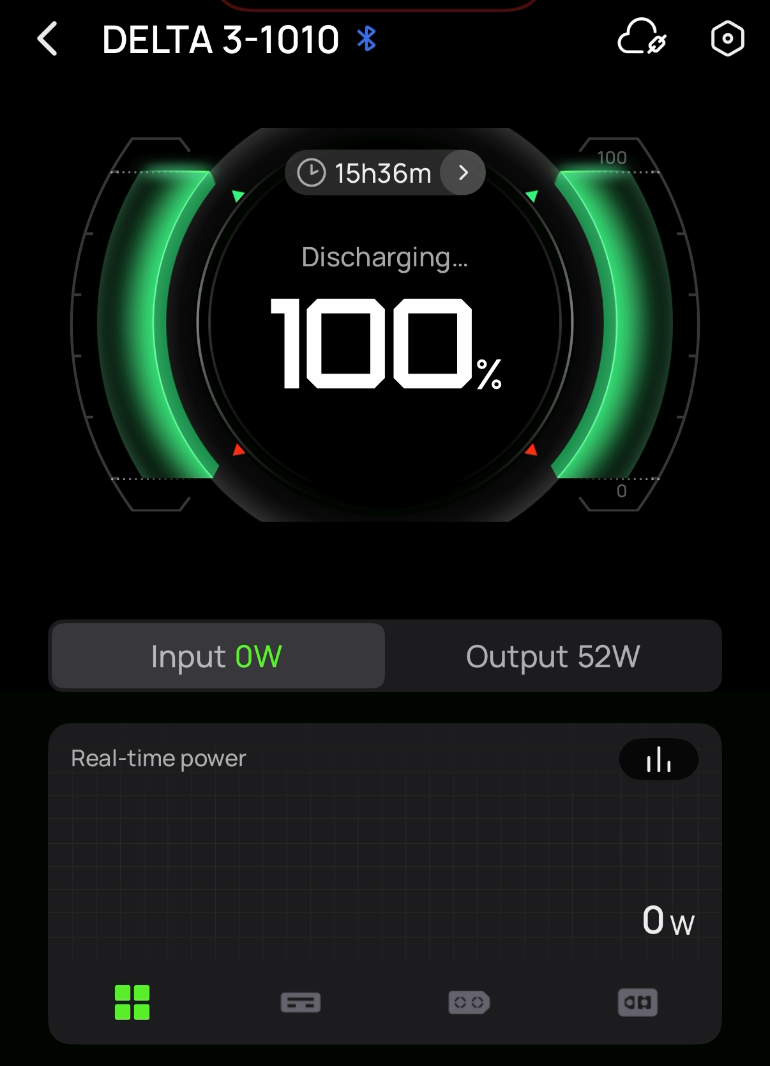
The question everyone asks, so here is our measured answer first. The EcoFlow Delta 3 ran our 60W camping fridge for about fourteen and a half hours on a single charge. Switched on at eight in the morning, it was still going well past bedtime.
The detail behind that number. Our fridge is an old Halfords twelve volt compressor unit, rated at about sixty watts. Its cigarette lighter plug packed up years ago, so it runs off the normal three-pin socket, which handily meant all three power stations we tested were doing exactly the same job in exactly the same way.
One thing genuinely surprised us. The Delta 3's screen consistently showed the fridge drawing around fifty watts, roughly ten watts less than the other two units reported for the same fridge. We cannot tell you for certain whether that is a more efficient inverter or simply a difference in how the meter reads. What we can tell you is that it stayed lower all week, and the EcoFlow ran the fridge about an hour longer than its rivals as a result.
In real life, that hour is the difference between the fridge giving up at nine at night and seeing you through to bedtime. Small on paper. Not small when it is your dinner in there.
If you are running a bigger household fridge rather than a camping one, expect less. A typical under-counter fridge cycling on and off will draw more over a day, and a fair working estimate is eight to twelve hours depending on the fridge and the weather.
That fourteen and a half hours was a 12V camping fridge. If you are wondering what it means for the fridge freezer in your kitchen, we have done the full maths on fridge runtime, including the one thing most guides get wrong about the losses.
How fast does the EcoFlow Delta 3 charge?

From empty to full in fifty-six minutes on a normal three-pin plug. We timed it on the trip, and it is genuinely that quick. On a campsite, that changes how you think about charging. You are not leaving it plugged in for an afternoon. You put the kettle on, sort the kids out, and it is done.
The practical upshot for a week without hook-up: the two or three times we did use a campsite charging point, the unit was full before the washing up was finished. Take the mains cable with you and an hour at a charging point resets your whole power supply for the day.
Solar charging: what a 200W panel actually delivers

We used a 200W folding solar panel all week, and this is the honest bit most spec sheets skip. In proper July sunshine, clear skies, panel angled at the sun, we saw about 150 to 160 watts actually going into the unit. That is normal. Panels almost never hit the number on the box outside a lab, so whatever panel you buy, expect roughly three quarters of its rating in good light.
At that input, the Delta 3 refills from empty in about six to seven hours of usable daylight. On a bright day that is a full recharge while you are out walking. On a grey day it becomes a top-up rather than a refill, and you are glad the campsite has a charging point.
Our rhythm by mid-week was simple. Fridge runs all day, panel goes out whenever it is light, and everything roughly balances.
One buying note. The Delta 3 comes with its mains cable but no solar connectors. If your panel is not an EcoFlow one, budget an extra ten to fifteen pounds for an MC4 to XT60 adapter cable before it will plug in. Order it with the unit and save yourself the wait we had.
Can the EcoFlow Delta 3 charge a campervan leisure battery?

Yes, and this might be the most useful thing we learned all week, because nobody's spec sheet mentions it.
We were parked on the same pitch for several days, so the van's leisure battery was getting nothing from the engine. Normally that is when you start rationing the van's lights and the water pump. Instead, we plugged the leisure battery's charger into the Delta 3, and it topped the van up without any fuss. We repeated it across the week and it worked every time.
If you have a campervan and you park up for days at a time, that one trick keeps the van's own systems alive, the lights, the pump, the heater controller, without running the engine or moving pitch. For us, it justifies carrying a power station on its own.
Living with it: the screen, the buttons and the app

The Delta 3 has eleven outputs. Four three-pin mains sockets, two USB-C ports at up to 100W each, two USB-A, a 12V car socket and two DC ports. In practice, that meant we never once had to unplug something to plug in something else, which with a family is the actual test.
The screen deserves a special mention. It stays bright and readable in direct sunlight, even wearing polarised sunglasses. That sounds like a small thing until you are stood in a field squinting at a display trying to work out whether the fridge will make it to morning. It is the best screen of the three units we tested.

The buttons are the same story. Big, clear, obvious switches, grouped sensibly, so you are not hunting through menus to turn the USB ports on. Whoever designed this actually imagined someone using it half asleep at seven in the morning.
The app is one of the better ones we have used. Clear, no bugs all week, and if you connect the unit to WiFi you get a full history of what went in and out, which is how we know our exact numbers. If you already own EcoFlow gear, everything sits in one app. We have the EcoFlow Wave 3 air conditioner, so for us that genuinely matters.
And there is an expansion socket. If 1,024Wh ever stops being enough, you can clip on an extra battery and take the system up to 5,000Wh. You are buying into a whole ecosystem, pun intended, not just a box. If you are eyeing up balcony solar or a bigger setup one day, that door being open is worth something.
How loud is the EcoFlow Delta 3?
Quiet enough that we stopped noticing it, which is the honest headline. Running the fridge and charging phones through the day, the fan sat there doing next to nothing. It was a couple of feet from where we sat in the awning and it never once made us look up.
The exception is the fast charge. Pulling a full battery in 56 minutes means shifting a lot of power, and that is when the fan actually spins up. You hear it. It is a steady whir rather than anything harsh, and it stops the moment the charge finishes. [Confirm here how loud it really was and whether it bothered you.] We got into the habit of topping it up during the day rather than last thing at night, so it was silent by the time anyone was trying to sleep.
So, the real answer. At rest and running a fridge, you will forget it is on. During a fast mains charge you will hear it for the best part of an hour, then it goes quiet. Across a week in a field with two kids, the fan was never the thing that bothered us.
One evening of movie night costs about two hours of fridge time
The bit that made the trip. A couple of evenings we set our Nebula projector up in the awning, plugged it into the Delta 3, and watched films while the kids worked through the marshmallows. The projector and four phones charging all at once, and the unit barely noticed.
For the numbers people, an evening like that used roughly ten percent of the battery, which works out at about two hours of fridge time. A trade we took happily. If you camp with kids, this is honestly the sales pitch. It is not the watt hours. It is an ordinary evening in a field turning into cinema night.
EcoFlow Delta 3 specifications
Specification | EcoFlow Delta 3 |
Capacity | 1,024Wh (LiFePO4) |
AC output | 1,800W continuous, 3,600W peak |
Mains sockets | 4 |
USB | 2 x USB-C (100W), 2 x USB-A |
Other outputs | 12V car socket, 2 x DC5521 |
Total outputs | 11 |
AC recharge | 0 to 100% in 56 minutes |
Solar input | Up to 500W (11 to 60V), XT60 port |
Expansion | Extra battery support up to 5,000Wh total |
Weight | 12.5kg |
Dimensions | Approx. 398 x 200 x 284mm |
Battery life | Rated around 4,000 cycles to 80% capacity |
A note on that battery rating: LiFePO4 chemistry is the long-life stuff. Four thousand cycles means that even charging it every single day, the battery is rated to keep the bulk of its capacity for around a decade. This is not a unit you will wear out quickly. |
What we didn't love
Honest bits, because there are a few.
It is slightly heavier and a touch bigger than some rivals in this class at 12.5kg. Not by much, but you notice it lifting it in and out of the van.
It is almost too nice. The finish is genuinely premium, and we found ourselves being careful with it in a way you should not have to be with camping kit. It is like wearing white linen trousers to a picnic. You absolutely get away with it, it does the job beautifully, but you would be nervous about the grass stains.
And there are no solar cables in the box, as mentioned above. A small thing, but worth knowing before you order.
Is the EcoFlow Delta 3 worth it? Our verdict
Final ratings
FRIDGE RUNTIME | ■■■■■ | 14.5 hours measured on our 60W fridge, the longest of the three, with the screen reading a curious 10W under its rivals. |
CHARGING | ■■■■□ | 56 minutes to full is genuinely quick. Only the world record holder does it faster, and not by much. |
SOLAR | ■■■■□ | Takes real-world sun without drama and tells you exactly what is coming in. Cables not included, budget a tenner. |
SCREEN & CONTROLS | ■■■■■ | The best screen and button layout we have used on a power station. Readable in full sun with sunglasses on. |
APP & ECOSYSTEM | ■■■■■ | Clear, bug-free, and one app runs everything if you own other EcoFlow kit. The expansion socket keeps the door open to 5,000Wh. |
BUILD FOR CAMPING | ■■■□□ | Premium and solid, but it is white linen trousers at a picnic. You get away with it, you just worry about the grass stains. |
After a week of real use, here is where we landed.
The Delta 3 is brilliant. The best screen we have used on a power station, the most intuitive layout, a genuinely good app, and a measured fourteen and a half hours of fridge time on one charge. It refills in under an hour from the mains, takes solar without drama, and quietly topped up our van's leisure battery all week. It stopped being a gadget by about day two. It was just part of the campsite.
Who is it for? If you want one unit that covers home backup, weekends away, and keeping a home office alive when the electric drops, and you like the idea of adding more battery later, the Delta 3 is an easy recommendation. It is polished, clever, and the expansion route means it grows with you. If you already own EcoFlow gear, the one-app ecosystem tips the scales further.
If your camping is more like ours, weeks away with kit slung in and out of a van, the build and ruggedness conversation gets more interesting, and that is exactly what our head-to-head against the Anker SOLIX C1000 Gen 2 and the AFERIY P180 covers. We are keeping that verdict for when all three are on the table.
Frequently asked questions
Is the EcoFlow Delta 3 waterproof?
No. Like almost all portable power stations, it is not waterproof or rated for rain. Keep it in the awning, the tent porch or the van, and keep it off wet grass. Treat it like you would a laptop.
How many watts is the EcoFlow Delta 3?
It delivers 1,800W of continuous power with a 3,600W peak. In practice that runs a camping fridge, laptops, a projector, fans, and most small appliances. A full-size 3,000W household kettle is beyond its continuous rating, so use a low-wattage camping kettle instead.
How much does the EcoFlow Delta 3 weigh?
12.5kg, roughly the weight of a full airline cabin bag. It has a solid handle and carries comfortably enough, though it is not the lightest in its class.
Can the EcoFlow Delta 3 run an air conditioner?
A portable camping air conditioner like the EcoFlow Wave 3, yes, though expect it to use the battery quickly. A household air conditioner is not realistic for a 1kWh unit.
What comes in the box?
The power station, a mains charging cable and a car charging cable. Solar connectors are not included, so budget for an MC4 to XT60 adapter if you plan to use a non-EcoFlow panel.
How do you charge the EcoFlow Delta 3?
Four ways: a normal three-pin mains socket (fastest, 56 minutes to full), solar up to 500W, a 12V car socket while driving, or a combination of mains and solar.
Is the EcoFlow Delta 3 fan loud?
Not in normal use. Running a fridge and charging phones, we barely heard it. It spins up during a fast mains charge, when it is moving a lot of power, then settles down again. If you want it silent overnight, top it up during the day rather than charging it as you go to bed.
The kit we used in this test
Everything on this list is what we actually ran for the week in the Lake District. Prices change often, so the links go to the live listing rather than a figure that goes stale.
ITEM | WHY IT IS ON THE LIST |
EcoFlow Delta 3 1,024Wh | |
200W Portable Solar Panel | |
MC4 to XT60 solar charging cable | |
Projector (movie nights) |
Get the deals before everyone else
Power station prices move around a lot, and the difference between full price and a good offer can be well over a hundred pounds. Sign up to our mailing list and we will let you know when the gear we have actually tested goes on offer, including current EcoFlow discounts, across all the brands we review. We will also email you the head-to-head results the moment they land.


Comments