


EcoFlow WAVE 3 Review: Does It Actually Work in a Tent or Drive-Away Awning?

Updated: Sep 23
We spent two weeks testing the EcoFlow WAVE 3 in real camping conditions — heating in the Swiss Alps, cooling at Lake Garda. Here's the honest version.

Does the EcoFlow WAVE 3 actually work as a portable air conditioner in a tent or drive-away awning? We ran it across two very different climates to find out — and came back with a clear answer.
By Carina · Nest Nomad & Beyond · Last Updated June 2026
Let's be honest. The idea of running an air conditioning unit inside a fabric awning sounds like exactly the kind of thing that sounds great on YouTube and falls apart the moment you try it in real life. Too much space. Too little insulation. Too many campsite variables. And yet, here we are.
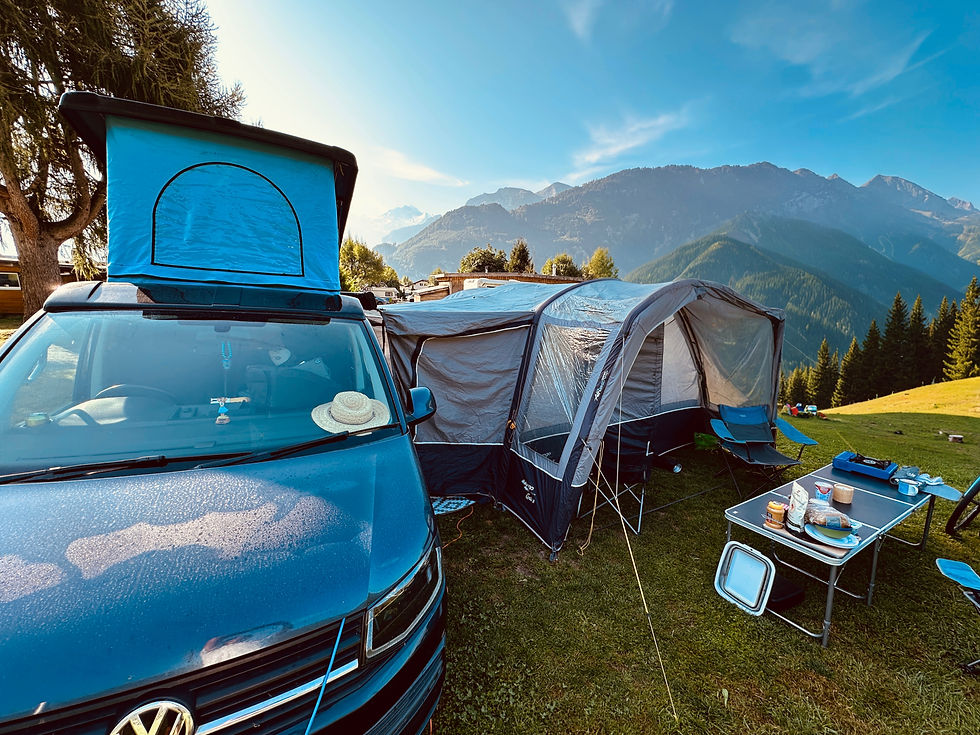
Last August we road-tripped from the UK through the Eurotunnel — VW T6 long wheelbase, Vango Valley 111 drive-away awning, two pre-teen girls, two very different destinations. Interlaken in the Swiss Alps first, then Lake Garda in northern Italy. Two countries, two climates at opposite ends of the thermometer, and armed with one EcoFlow WAVE 3 with the 1024Wh add-on battery. Time would tell.
We'd been doing European camping road trips for over seven years. We've never needed perfect conditions to have a brilliant time. But we'd also spent seven summers accepting that good sleep and hot weather were largely incompatible. Not so, it would seem, anymore.
The Verdict First Off
It kept us warm at 6°C in Switzerland. It kept us cool at 30°C in Italy. In seven years of European camping, that has never happened before.
So, for the short version of our EcoFlow WAVE 3 camping review: yes, a portable air conditioner works in a drive-away awning, and it works well. The performance across both heating and cooling functions in real camping conditions — not a controlled room, not a static test, but an actual uninsulated fabric awning — matched what EcoFlow claims.
If you're a family, couple or solo camper who heads to warm climates in summer or shoulder season, this changes what a camping trip can feel like.
The Setup: Why We Needed It
When we pitch for a week or more, we sleep in the awning rather than the van — it keeps the van in 'day mode' with the seats up, fridge accessible and everything a functioning space. The awning essentially becomes our bedroom. It works brilliantly until the temperature ends up being the elephant in the 'canvas' room.
Interlaken at altitude dropped to around 6°C overnight, so cold — especially in August. Lake Garda in late summer barely fell below 23°C at night. We needed something that could handle both ends of that range inside a fabric structure — and we were sceptical that a portable AC unit was the answer. How good could it really be?
But it is good. Really good. That said, there are just a few things worth knowing before you buy.
About the Noise — Let's Address the Amazon Reviews
The WAVE 3 is not silent. In sleep mode it runs at around 44 dB — roughly the level of a quiet conversation. In practice it sits firmly in white noise territory: a low, steady hum rather than a mechanical racket. The kind of background sound that, once you stop thinking about it, you stop hearing.
What we actually found was that it crossed over into the science around white noise and getting babies to sleep. European campsites are not quiet places — late arrivals, neighbouring pitches, and there's always one pitch who thinks it's entirely reasonable to have a full-volume conversation at nearly midnight. The WAVE 3 softened all of it. Muffled the campsite sounds that used to pull us from our slumber. Within a couple of nights it had gone from something we were conscious of to something we appreciated. Both kids slept really well throughout. We all did. That's probably the most honest endorsement I can give it.

Testing the Heating Function: Swiss Alps, 8°C Overnight
Interlaken is spectacular but it is a mountain destination, and it can get cold. Overnight we hit 8°C on more than one occasion even though it was August. The WAVE 3 delivers 6,800 BTU of heating and EcoFlow claims it can raise a 10 sqm space by around 9°C within 15 minutes. Inside our Vango Valley 111 awning, we can confidently say it absolutely delivered on that claim.
We walked into a warm space every evening, slept comfortably through the night, and woke up feeling toasty. When it was too cold to sit outside in the later evenings, we snuggled up with our Nebula projector and watched movies feeling, frankly, a little bit smug. Walking back into a cosy awning from cold Alpine air outside — we were converted from night one.

Testing the Air Conditioning Function: Lake Garda, 25°C Overnight
Lake Garda in late August is everything a summer camping trip should be. It's also, by 3pm, roughly the temperature of the inside of a car parked in direct sunlight, and overnight temperatures barely dropped below 23°C. Without climate control, sleep on a Garda summer night can be a bit of an endurance exercise.
We ran the WAVE 3 on electric hook-up throughout the Garda portion of the trip, ducting the exhaust hose through a front zip in the awning. The cooling was fast and consistent — 6,100 BTU doing exactly what it's supposed to do. The awning was a genuinely different environment to outside.
Quick science - Higher BTU = More cooling power. 6,800BTU is strong for a portable unit!
The morning improvement was the single most noticeable quality-of-life change of the whole trip. Anyone who has camped in summer heat knows what 7am (or earlier — 5.30am anyone?!) in a fabric structure with direct sun exposure feels like. With the WAVE 3 running, we had cool, unhurried mornings. Our eldest — who genuinely cannot function in heat — was able to doze a bit longer than she would have otherwise. As it should be on holiday. Getting two early teenagers dressed and packed for a full day of activities without anyone melting, losing something under a pile of PJs, or needing to be reminded three times that we were supposed to leave twenty minutes ago — that's the real-world product demo right there. And I for one, am grateful.
If anything, the mornings became slightly too relaxed. It turns out that packing a backpack becomes a noticeably slower process when there's air conditioning to linger in.
For the first time in seven years of European camping — no mosquitoes. Sealed awning, climate-controlled space. We hadn't fully considered that as a benefit before we left. We're very aware of it now.
Keeping cool is only half of a good night under canvas. We've covered the rest in our family camping sleep setup guide.
Practical Setup: What You Need to Know Before You Buy

The 15-Degree Tilt — Read This Before You Pitch. And Do It!
The WAVE 3 manual specifies a 15-degree forward tilt for the unit to drain correctly. We didn't pay close enough attention to this in the first couple of days. The result was a significant amount of water on the awning carpet — not a small damp patch, enough that we had to lift the unit out completely, empty it, dry the floor properly, and reset everything from scratch.
Nobody wants soggy carpet in a tent. In a British camper's soul, keeping the inside of your tent dry is essentially a primal instinct — and having water from the wet carpet seeping into whatever clothing the kids had conveniently left on the floor was not the finest moment of the trip. Entirely our fault, entirely avoidable. We found a piece of old kindling in the back of the van, propped the front edge up to achieve the required angle, and the problem stopped immediately and completely.
One honest criticism at this price point: there should be a built-in mechanism to achieve and hold the drainage angle. Campsite ground is inherently uneven — that's the nature of the terrain — and a unit at £799 asking you to source your own solution (in our case, a bit of old kindling) on arrival feels like an oversight. An adjustable foot system would solve it entirely and costs almost nothing to engineer in.
Drain Pipe Placement
The excess water pipe exits through the same opening as the exhaust duct — tidy design logic. When you're planning your pitch, make sure you think about where that pipe will sit relative to your awning. Ideally the water drains away from your footprint rather than underneath it. When you're setting up new kit after a long drive, quick decisions can have frustrating consequences. Worth keeping in mind.
Storage and Weight in a Campervan Setup
The unit itself is manageable — roughly the size of a 20-inch carry-on suitcase with a handle. The 1024Wh add-on battery is where the weight lives: around 9.7 kg of dense, solid kit. It needs a practical home that isn't the middle of the floor. So often in a van, caravan or tent, you end up moving things to access other things — it's simply not practical for that to happen here.
Our solution: the fold-away camping table that lives in the awning anyway. Camping fridge tucked underneath, battery alongside it, unit on top, exhaust and drain pipe heading out through the front zip. Everything contained, nothing in the way, airflow directed straight at the sleeping area. Think through the placement before you pitch rather than after.
The App — Genuinely One of the Best Features
The EcoFlow app deserves more than a mention in the specs table. Temperature adjustment from a phone without getting up, without waking anyone, without fiddling with the control panel in the dark. Someone moaning they're too hot — sorted in seconds without getting out of bed. Someone too cold — same deal. The temperature response is quick: a few minutes at most before you notice the difference.
For anyone who has ever had a late-night temperature negotiation in a tent, this is a significant quality-of-life improvement. Real-time power monitoring, scheduling, and water drain notifications round it out. It feels like a premium smart home device that happens to work equally well on a small plot of land in Italy.
Power Options: Hook-Up, Battery, and Off-Grid
We ran on electric hook-up for this trip. But the 1024Wh add-on battery is designed for exactly the situation where you don't have that option — up to 8 hours of wireless running in Eco Mode, which we can confirm from home use is a realistic figure, consistent with EcoFlow's guidance. That's a full night without any connection to mains power.
We also have a Bluetti EB portable power pack and solar kit and plan to test this summer how long we can genuinely sustain the WAVE 3 on solar alone. That experiment will get its own post when we have the real-world data. The WAVE 3 battery supports AC mains, solar panels, 12V/24V car charging, and the EcoFlow Alternator Charger — meaning the battery can be replenished while driving between destinations, which for long road trips is a meaningful practical advantage.
Anyone kitting out a broader family adventure setup alongside gear like inflatable SUPs, projectors, and portable power — we cover all of it here.
If you're building out an off-grid kit, the WAVE 3 pairs well with the gear in our outdoor Father's Day gift guide, which includes the EcoFlow RIVER 3 Plus.
The Dehumidifier Mode
The WAVE 3 runs a dedicated dehumidify mode, separate from cooling and heating. We didn't have cause to test it properly on this trip but it's a feature we're curious about for shoulder season camping and condensation management in fabric structures. We'll cover it properly once we've used it in the right conditions.
A Note on the Furry Members of the Family

Storm and Nala — our two chow chows — didn't join us on this trip — Italy at that time of year would be way too hot and restrict what we could practically do during the day. But we do use the WAVE 3 at home to keep them comfortable in the summer heat, and it's become a genuinely useful part of how we manage warm weather for them. That deserves its own post and it will get one.
What We'd Change
The drainage angle is our primary criticism and it's a small but genuine one. The 15-degree tilt requirement is reasonable in principle — the physics makes sense — but on uneven campsite ground it needs a solution built into the product. At this price point, an adjustable foot system is not an unreasonable expectation. As it stands, you're finding your own workaround on arrival. It's not a deal breaker, but it does feel like it could have been better thought out.
The battery weight is what it is — 9.7 kg needs to be factored into your packing and storage before you commit. For a fixed-pitch setup it's a non-issue. For pitches where you're moving regularly, it's worth thinking through.
Those are the two honest reservations. Everything else — performance, power consumption, app, noise level — totally delivered.
Who Is the EcoFlow WAVE 3 For?
If any of the following sounds familiar, it's worth serious consideration:
Families who camp in Europe in summer and have spent too many trips managing tired, overheated kids.
UK campers doing shoulder season trips where overnight temperatures are genuinely unpredictable.
Van life, motorhome, or caravan setups where climate control matters for longer stays.
Drive-away awning users who want to use the awning as a proper bedroom, not just a slightly warmer version of outside.
Anyone who has accepted that summer camping means not sleeping well — and would quite like to stop accepting that.
EcoFlow Wave 3 review: Final Verdict.
The EcoFlow WAVE 3 with the 1024Wh add-on battery is not a lightweight purchase — in either sense — and it's not for everyone. But it did exactly what it claimed, in conditions that would have defeated a lesser unit. The heating worked in the Alps. The cooling worked at Garda. The low-level white noise became a benefit. The app is excellent. The one real criticism — the drainage angle — is minor and fixable in thirty seconds once you know about it.
We went in sceptical. Now, it's a permanent addition to the packing list for future trips.
The Wave 3 is a summer product, but the power station you bought to run it is not. We have since worked out how long a power station will run a fridge freezer in a power cut, which is the job it will be doing for you from about October onwards.
COOLING | 6,100 BTU. Brought the Lake Garda awning to a comfortable sleeping temperature within 15 minutes on the hottest nights. Matched the spec sheet claim in real conditions. |
HEATING | 6,800 BTU. Comfortable at 8°C in the Alps overnight. Warm enough for a civilised morning with no layers required. |
NOISE | 44 dB sleep mode. White noise territory — not silent, but actively useful for masking campsite sounds. Both kids slept well throughout. |
APP | Genuinely excellent. Temperature managed from a phone in bed. Quick response. One of the best features, not just a spec-sheet tick. |
BATTERY | 8 hours wireless in Eco Mode — confirmed consistent with home use. Solar-only test planned for this summer. Results to follow. |
ONE CRITICISM | The 15-degree drainage tilt needs a built-in solution. Campsite ground is uneven by nature. At this price, an adjustable foot shouldn't be an afterthought. |
Affiliate links may be used in this post. We only recommend products we have personally tested. Full affiliate disclosure here.
Frequently Asked Questions
Real questions. Answered from genuine first-hand use across two countries and two seasons.
Does the EcoFlow WAVE 3 actually work in a tent or drive-away awning?
Yes — and better than we expected. We ran it inside a Vango Valley 111 drive-away awning, an uninsulated fabric structure. It cooled effectively on Lake Garda nights that didn't drop below 23°C and heated comfortably at 8°C in the Swiss Alps. The key is directing airflow toward your sleeping area and ensuring the exhaust hose has a clean exit point. Fabric structures lose heat and cool faster than a fixed room — but the WAVE 3 handles that.
How noisy is the EcoFlow WAVE 3 — can you sleep with it running?
It runs at 44 dB in sleep mode — roughly equivalent to a quiet conversation. Not silent, but firmly white noise territory: a low, steady hum rather than mechanical noise. In practice we found it improved sleep by masking campsite sounds. You'll notice it the first night. Most people stop hearing it after that.
How long does the EcoFlow WAVE 3 battery last?
Up to 8 hours in Eco Mode with the 1024Wh add-on battery — and based on home use we can confirm this is a realistic figure, not just a best-case claim. Real-world runtime varies with ambient temperature and load. In peak cooling mode on a very hot night expect 5–6 hours. In Eco Mode in moderate conditions, 8 hours is achievable. Full recharge in 75 minutes via AC combined with solar.
Can you use the EcoFlow WAVE 3 without electric hookup — fully off-grid?
Yes. The 1024Wh add-on battery is built for exactly this — up to 8 hours of wireless operation covers a full night without shore power. Recharge options include solar panels, 12V or 24V car outlet, and the EcoFlow Alternator Charger while driving. We ran on hook-up for this trip but are testing a solar-only setup this summer. Results will be published here.
Does the EcoFlow WAVE 3 work as a heater as well as an air conditioner?
Yes, and effectively. At 6,800 BTU it raised our awning from 8°C ambient to comfortable sleeping temperature in Interlaken without issue. EcoFlow claims a 9°C rise in a 10 cubic metre space within 15 minutes — that absolutely held up in practice. Not a substitute for a gas heater in extreme cold, but for shoulder season camping and cold European summer nights it's genuinely capable, and way safer.
Does the EcoFlow WAVE 3 leak water?
It can — if you don't set it up at the correct angle. The manual requires a 15-degree forward tilt for proper drainage. We missed this initially and had significant water on the awning carpet — enough to require a full reset. Propping the front of the unit up solved it immediately and completely. Plan this before day one. Also consider where the external drain pipe exits relative to your awning when pitching, ideally draining away from your footprint, not underneath it.
What size space does the EcoFlow WAVE 3 cool or heat?
EcoFlow rates it for 11–17 square metres (118–183 sq ft). A typical drive-away awning falls comfortably within this. For larger or open-ended structures performance will drop, the WAVE 3 works best in an enclosed space where it can hold the temperature it creates.
Is the EcoFlow WAVE 3 worth it for family camping?
For families camping regularly in warmer or cooler climates — yes. The price is significant at £1,299 with the battery bundle, but so is the quality-of-life difference. Years of summer camping before this trip meant accepting that good sleep and hot weather were largely incompatible. The WAVE 3 has totally changed that. As any parent knows, everything looks better on a good night's sleep. Whether the price is worth it depends on how often you camp and how much the temperature has historically affected your trips. It's an investment in comfort whilst you're away — and honestly, isn't that what a holiday should be?
Can the EcoFlow WAVE 3 be used in a campervan or motorhome?
Yes — it's specifically designed for van life, RV, and overlanding use. Compact form factor, multiple power options, and a carry handle make it practical for mobile living. In our setup we stored the battery and unit under the camping table in the awning. For permanent installs, the exhaust duct needs a fixed exit point — straightforward with a basic vent fitting.
Does the EcoFlow WAVE 3 have a dehumidifier mode?
Yes — a dedicated dehumidify mode separate from cooling and heating. We haven't had proper cause to test it yet but it's a practical feature for wet weather camping and condensation management in fabric structures. We'll cover it in detail once we've used it properly.
Product Specifications at a Glance
Specifications sourced from Amazon UK listing and EcoFlow UK product page.
SPECIFICATION | DETAIL |
Cooling Power | 6,100 BTU |
Heating Power | 6,800 BTU |
Operating Modes | Cooling / Heating / Dehumidify / Fan / Auto / Sleep / Eco |
Add-On Battery Capacity | 1,024Wh LiFePO4 (LFP) |
Battery Runtime (Eco Mode) | Up to 8 hours wireless |
Fast Charge Time (AC + Solar combined) | 75 minutes to full |
Noise Level (Sleep Mode) | 44 dB — approx. quiet conversation level |
AC Unit Dimensions | Approx. 518 × 297 × 337 mm (20.4" × 11.7" × 13.2") |
AC Unit Weight | Approx. 15.3 kg (33.7 lbs) |
Add-On Battery Dimensions | Approx. 516 × 282 × 112 mm (20.3" × 11.1" × 4.4") |
Add-On Battery Weight | Approx. 9.7 kg (21.4 lbs) |
Combined Weight (Unit + Battery) | Approx. 25 kg (55 lbs) |
Cooling Area Coverage | 11–17 sqm / 118–183 sq ft |
Temperature Drop (15 min) | Up to 8°C in a 10 sqm space |
Temperature Rise (15 min) | Up to 9°C in a 10 sqm space |
Refrigerant | R290 (eco-friendly, reduced CO₂ emissions) |
Water Resistance Rating | IP65 (AC unit) |
Battery Lifespan | 4,000+ charge cycles (retains ≥80% capacity) |
Charging Methods | AC mains / Solar / Car 12V or 24V / EcoFlow Alternator Charger |
Smart App Control | Wi-Fi + Bluetooth — EcoFlow App |
App Features | Temp control, scheduling, PetCare mode, water & power alerts |
Drainage | Auto-drain + manual button + external drain pipe |
Installation Requirement | 15° forward tilt required for correct drainage |
UK Retail Price (unit only) | £799 |
UK Retail Price (unit + battery bundle) | £1,299 |
Related Reading
More posts coming soon — check back or sign up to be first to know.
More from Nest Nomad & Beyond
Enjoyed this review? Before you spend another penny on kit that looks good on paper and lets you down in real life — our free 'Don't Waste Your Money 2026 Guide' is for you. Honest picks across home, outdoor, and tech. Sign up here and we'll send it straight over!


How about in Spain climate, at 35-45celsius, you think will help me sleep in need?