


AFERIY P180 Review: A Week Off-Grid With the Budget Power Station

Updated: Sep 23
AFERIY is a brand a lot of people have not heard of, at a price that makes you look twice, so the question we set out to answer was a simple one. What do you actually give up by saving that money?

By Martin · Nest Nomad & Beyond · Last Updated August 2026
AFERIY P180 review: the honest verdict after a week off-grid
Welcome to our AFERIY P180 review. This is the cheapest of the three power stations we took to the Lakes for a week off-grid, and it was often a couple of hundred pounds cheaper than the other two, depending on the deals running that week. It is the AFERIY P180, sometimes sold as the Nomad1800.
We ran it the same way we ran the others: a week with no hook-up, a 12V fridge on all day, lights, phones, a projector for the odd film night, and solar to top it up. Here is everything we measured, the good and the awkward, including the odd moment on day three that we will come to. Our full portable power station roundup is here.
A 12V fridge is a harder load than most people expect. We compared how long it ran our fridge against two other 1kWh units, and worked out what that means for a kitchen fridge freezer.
At a glance
Spec | AFERIY P180 (Nomad1800) |
Capacity | 1024Wh LiFePO4, rated 4000+ cycles |
Inverter | 1800W pure sine wave |
Weight | 11.6kg |
Output ports | Nine: 2 AC, 2 USB-A (18W), 2 USB-C (up to 140W), 2 DC, 1 car socket |
Full charge (mains) | About 70 minutes |
Fridge runtime (our test) | Roughly 13.5 to 13.75 hours |
In the box | Solar charging cable included |
Warranty | 2 years standard, up to 7 years buying direct |
Who is AFERIY, and is it a good brand?
Fair question, and probably the one that brought you here. AFERIY is a younger name in portable power than the big two, and it sits at the value end of the market. The P180 uses a LiFePO4 battery rated for more than four thousand charge cycles, which is the same battery chemistry the pricier units use and the part that matters most for how long it will last. The warranty is two years as standard, and up to seven years if you buy direct from AFERIY rather than through a marketplace, which is worth knowing before you decide where to order.
Our honest read after a week: the core of this unit is sound. The cell chemistry is right, the inverter is a proper pure sine wave one, and it did the job we asked of it. Where a younger brand shows its age is in the software and the finish, and we will be straight about both further down.
Will the AFERIY P180 run a fridge?
This is the number most people want, so here it is. Running our 12V compressor fridge as the main draw, the P180 kept it going for roughly thirteen and a half to thirteen and three quarter hours on a full charge before it needed topping up. That is a real overnight and most of the next day for a fridge on its own, and it lands within an hour of the other two units we tested, which all sit in the same ballpark.
In plain terms, a 1024Wh battery running a modern low-draw fridge will comfortably see you through the night and into the following afternoon. Add a solar panel in daylight and you stretch that further, which for most weekend and week-long trips means you are simply not thinking about power.
How fast does the AFERIY P180 charge?
From flat to full on mains took about seventy minutes in our testing, which is quick for the money and close enough to the pricier units that you would not feel short-changed. If you are the kind of camper who tops up at a service stop or on a short burst of hook-up, that speed matters more than it sounds.
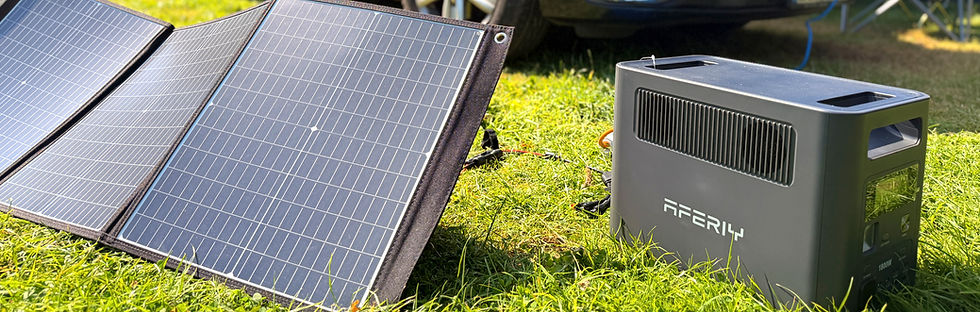
One detail worth flagging in AFERIY's favour: the solar charging cable comes in the box. Neither of the other two units we tested included one, so if you plan to add a panel, that is a small saving and one less thing to order separately.
The wobble: what happened on day three
We are going to tell this one straight, because it is the reason a review like this exists. On the third day, the screen showed a reading that made no sense, a charge figure that could not have been right. It was the sort of thing that makes your stomach drop when you have paid for a unit from a brand you are still getting to know.
Here is the important part. The power never actually failed. The fridge kept running, the outputs kept working, and once we cycled the unit the reading settled back to normal and behaved for the rest of the week. Our read is that this was a software display glitch rather than a fault with the battery or the electronics, and it is exactly the kind of thing a firmware update tends to iron out. It did not happen again.
We are not going to pretend it did not happen, and we are not going to tell you it means the unit is broken, because neither would be honest. If you like a brand with years of polished software behind it, that is a fair thing to weigh. If you can live with a younger product that did the actual work without missing a beat, it is a footnote.
Build, weight and the cagoule

The P180 is boxier than the curvier units from the big two, and the handle and shape make it feel heavier than it is. On the scales it is 11.6kg, which is lighter than the EcoFlow and within a few hundred grams of the Anker, so the honest line is that it is lighter than it looks but carries like the heaviest of the three.

The finish is where the price shows. It is the bargain supermarket cagoule of power stations. It does the job, it keeps you dry, and nobody is going to stop you in the car park to admire it. That is not a criticism so much as a description. You are paying less, and the casing is where the saving lives, not in the battery that matters.
Living with it
Day to day it was easy to get on with. Nine output ports covered everything we plugged in: two mains sockets, two USB-A, two USB-C with the higher one pushing up to 140W for a laptop, two DC outputs and a 12V car socket. The app let us keep an eye on things from the tent, though it lagged a little, which is common at this end of the market.
The built-in UPS is a nice touch if you ever want to run something at home through it during a power cut, with a fast switchover that most sensitive kit will not notice.
What we did not love
The small stuff, gathered honestly in one place. The app is functional rather than slick. The screen glitch on day three, covered above, is the headline one. The boxy shape is less comfortable to carry any distance than the rounder rivals. And the pronunciation of the name is anyone's guess, which is a daft thing to note but a real one.
None of these are dealbreakers on their own. Together they are the picture of a capable unit made to a price, which is exactly what it is.
Our verdict at a glance
What we judged | Score | In a line |
Value for money | 4.5 / 5 | The reason to look at it in the first place |
Fridge runtime | 3.5 / 5 | A night and beyond, in the same ballpark as the rest |
Charge speed | 4 / 5 | About 70 minutes to full, quick for the money |
Build and finish | 3 / 5 | Boxy and plain, this is where the price shows |
Ports and outputs | 4 / 5 | Nine ports, 140W USB-C, covers most kit |
Portability | 3.5 / 5 | Lighter than it looks, carries like the heaviest |
Overall | 3.8 / 5 | An honest budget pick |
Who the AFERIY P180 is for
If this is your first power station and you want to spend as little as possible without buying something that will let you down, the P180 makes a strong case. The battery is the right chemistry, it ran our fridge for a proper night and beyond, it charges quickly, and the solar cable in the box is a small kindness. For weekends, festivals, occasional off-grid trips and as a backup at home, it is a lot of unit for the money.
Where we would pause is heavy, everyday van life. If this is going to be knocked about daily for years, the finish and the younger software are worth thinking about, and it may be worth weighing against the sturdier options. That is a comparison we are saving for the full head-to-head, where all three units go up against each other properly.
For now, the question we opened with. What do you give up by saving a couple of hundred pounds? Less than you might fear, and mostly in the places you touch rather than the places that power your trip. Whether that trade is right for you is the honest open question, and the roundup is where we settle it.
Frequently asked questions
Will the AFERIY P180 run a fridge overnight?
Yes. In our week off-grid it ran a 12V compressor fridge for roughly 13.5 to 13.75 hours on a full charge, a full night and into the next afternoon, and longer with solar in daylight.
How long does the AFERIY P180 take to charge?
About seventy minutes from flat to full on mains in our testing, which is quick for the price.
Is AFERIY a good brand?
AFERIY is a younger, value-focused name. The P180 uses a LiFePO4 battery rated for over 4000 cycles and carries a two-year warranty, up to seven years buying direct. The core is sound; the software and finish are where the lower price shows.
What is the difference between the AFERIY P180 and the P180 Pro?
The plain P180 (Nomad1800) is a fixed 1024Wh unit. The P180 Pro is expandable to a much larger capacity. We tested the plain P180.
Does the AFERIY P180 come with a solar cable?
Yes. The solar charging cable is included in the box, which the other units we tested did not include.
How heavy is the AFERIY P180?
It weighs 11.6kg. It feels heavier than it is because of the boxy shape, but it is lighter than the EcoFlow and close to the Anker.
Shop the Kit
Item | Why it is on the list | Link | |
The unit | AFERIY P180 (Nomad1800) | The power station itself, the plain 1024Wh model we tested | |
On Amazon | AFERIY P180 on Amazon UK | For Prime delivery and easy returns. US readers redirect via OneLink | |
Solar | AFERIY 100W / 200W / 400W panel | To top up in daylight and stretch fridge runtime. Cable already included | Buy Direct |


Comments